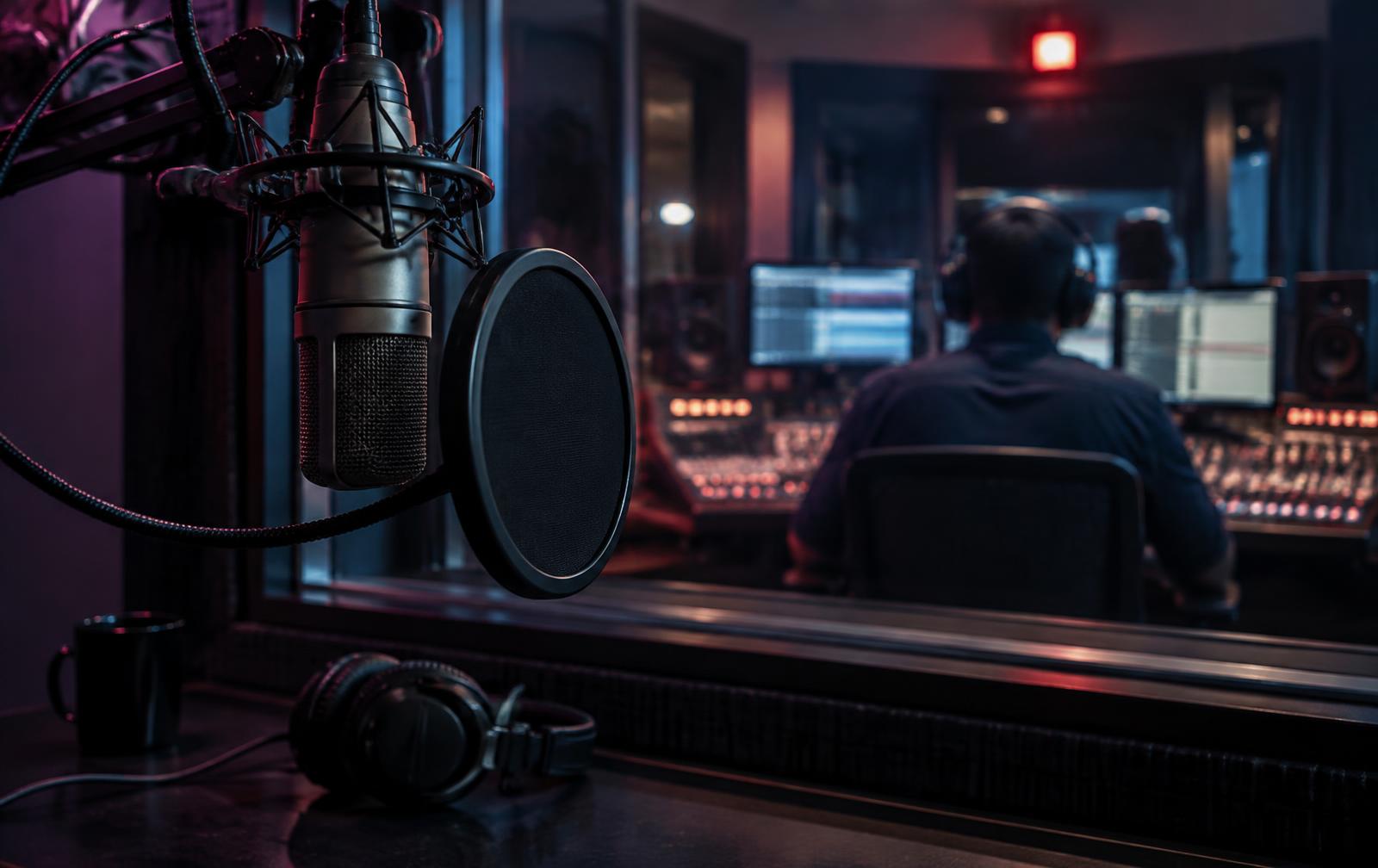
There is a person behind a station voice. Not just a timbre, but a lifetime of choices about where to lean into a line, when to leave space, and how to sound at home between two records.
That distinction matters when the voice can be reproduced. RoboJock trains its voices from real radio voicetracks made by actual radio professionals. It does not start by inventing an artificial announcer and asking a station to pretend that person belongs there. The original performance is the point of departure; the work of programming remains the point of arrival.
A recorded track is more than a sample.
Listen closely to a seasoned jock going into an intro. The words may be simple, but the delivery answers several questions at once: Is this a tease or a reset? Is the song a big event or a quiet landing? Is the audience coming out of a commercial break or an emotional record? Training from real voicetracks means learning from performances shaped by those decisions. It does not mean a model inherits the professional's judgment.
That is the line too many conversations about “AI voices” skip. A recognizable voice can reproduce sound; it cannot be held responsible for the editorial choices made in its name. Someone still chooses what it says, which take airs, and whether a line belongs on this station on this day.
The direction stays with professionals.
Provenance is not permission.
Saying that a voice comes from a real performer answers an important question about origin. It does not, by itself, answer who can authorize a replica, for what uses, for how long, or what happens when the relationship changes. Those are separate decisions and they deserve direct answers from any vendor using a person's voice.
The U.S. Copyright Office's digital-replicas report identified gaps in existing protections and recommended a federal law against knowing distribution of unauthorized replicas. That was a recommendation, not a statement that one uniform federal licensing regime already exists. In 2026, the National Association of Broadcasters and state broadcasters associations backed legislation aimed at unauthorized recreations of people's voices and likenesses. Their concern is not hypothetical: local trust is part of the broadcast product.
For a station evaluating a professional cloned voice, the diligence questions are practical: Whose performances supplied the training material? What permission covers the intended use? Who can request a change or stop future use? Who is responsible for the script, the approved take, and the final aircheck? These are questions to ask, not claims that every service already has the same answers.
Sounding like someone is not sounding like a station.
Even a faithfully reproduced voice can miss the room. A wrong neighborhood name, a line written for the wrong format, or a read that carries too much energy into a quiet song can undermine what the performer spent years building. The station's vocabulary, pronunciation, pace, and sense of occasion must be directed by the people who know that audience.
That is why the promise of this technology cannot be “pick a voice and walk away.” It has to be a working relationship among talent, programmers, producers, and the system delivering their decisions. Partnership on AI's synthetic-media framework centers consent, disclosure, and transparency as responsible practices; its voice-cloning case study also describes the real difficulty of balancing disclosure with a creative listening experience. Neither is a substitute for a station's own policy.
The real standard is authorship.
Radio has always involved tools: recorded elements, editing, processing, and automation. The question is whether those tools leave a clear path back to the people whose work makes the station sound like itself. A professional's voice should not become a generic asset. A programmer's judgment should not become a checkbox. A listener's trust should not depend on a technicality.
Begin with the person who made the original tracks. Keep the station team in charge of what those tracks become. Then make every resulting break answer to the same editorial standard as any other element going to air.